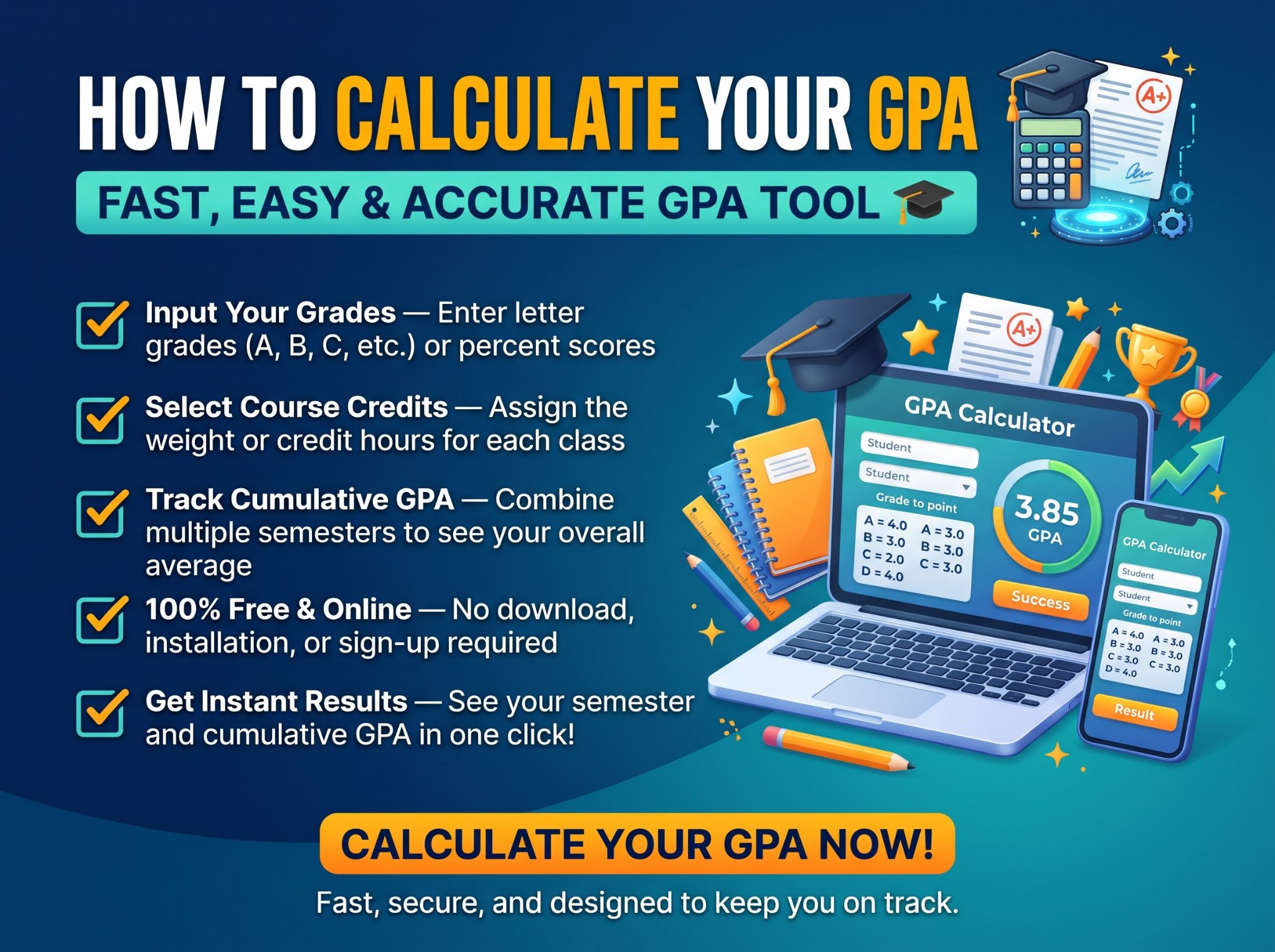
Your GPA looks like a single small number, but it decides scholarships, honours lists, internships, and college applications. The good news: the maths behind it is simple, and once you understand it, you can predict your GPA before grades are final — and work out exactly what you need to reach a target.
This guide walks through the formula, the standard 4.0 grade chart, and worked examples for semester and cumulative GPA. If you would rather skip the arithmetic, the free GPA calculator does everything below in seconds — but read on if you want to understand what it is doing.
The GPA Formula
GPA is a weighted average of your grades, where the weight is the credit hours of each course:
GPA = Total grade points ÷ Total credit hours
Each course contributes grade points = the value of your grade × the course’s credit hours. A grade in a 4-credit course moves your GPA more than the same grade in a 1-credit course. That single fact explains most surprises students get from their GPA.
The 4.0 Grade Points Chart
On the standard unweighted scale used by most US high schools and colleges, letter grades convert to points like this:
| Grade | Points | Grade | Points | Grade | Points |
|---|---|---|---|---|---|
| A+ | 4.0 | B+ | 3.3 | C+ | 2.3 |
| A | 4.0 | B | 3.0 | C | 2.0 |
| A− | 3.7 | B− | 2.7 | C− | 1.7 |
| D+ | 1.3 | ||||
| D | 1.0 | ||||
| D− | 0.7 | ||||
| F | 0.0 |
Some schools treat A+ as 4.3, and some do not use plus/minus grades at all (A = 4, B = 3, C = 2, D = 1, F = 0). Always check your own school’s chart — the method stays the same either way. This is the same scale used by the Trencada GPA calculator.
How to Calculate Your Semester GPA (Worked Example)
Say your semester looks like this:
| Course | Grade | Grade points | Credits | Points × credits |
|---|---|---|---|---|
| English | A | 4.0 | 3 | 12.0 |
| Maths | B+ | 3.3 | 4 | 13.2 |
| Biology | A− | 3.7 | 4 | 14.8 |
| History | B | 3.0 | 3 | 9.0 |
| Physical Education | A | 4.0 | 1 | 4.0 |
| Total | 15 | 53.0 |
GPA = 53.0 ÷ 15 = 3.53
Notice how the B+ in 4-credit Maths pulled harder than the A in 1-credit PE. When you are choosing where to focus your study time, credit hours tell you where a grade improvement pays off most.
To do this faster, enter your courses, grades, and credit hours into the GPA calculator — it handles both semester and cumulative GPA, and there is no signup.
How to Calculate Cumulative GPA
Cumulative GPA combines every semester, and the correct way is not to average your semester GPAs — unless every semester had identical credit hours, that shortcut gives the wrong answer. Instead, add up the grade points and credit hours across all semesters:
Example:
- Semester 1: 53.0 grade points over 15 credits (GPA 3.53)
- Semester 2: 54.4 grade points over 16 credits (GPA 3.40)
Cumulative GPA = (53.0 + 54.4) ÷ (15 + 16) = 107.4 ÷ 31 = 3.46
If you had simply averaged 3.53 and 3.40, you would have got 3.47 — close here, but the error grows when semesters have very different credit loads. The cumulative mode in the GPA calculator does the credit-weighted maths for you.
Weighted vs Unweighted GPA: What Is the Difference?
- Unweighted GPA uses the plain 4.0 scale above. It treats every class the same, whether it is a standard class or the hardest one in the school.
- Weighted GPA gives extra points for harder classes — commonly +1.0 for AP and IB classes and +0.5 for honours classes — so the scale runs to 5.0 instead of 4.0. An A in an AP class can be worth 5.0 points.
That is why a weighted GPA can be higher than 4.0, and why you should never compare two students’ GPAs without knowing which scale each school used. Colleges know this and typically look at your transcript in context; many recalculate GPAs on their own scale.
If you are tracking AP performance specifically, our AP Score Calculator estimates your 1–5 AP exam score from practice-test results.
How to Convert Percentage Grades to a 4.0 GPA
If your school grades in percentages, convert each course grade first, then apply the formula. A widely used conversion is:
| Percentage | Letter | GPA points |
|---|---|---|
| 93–100 | A | 4.0 |
| 90–92 | A− | 3.7 |
| 87–89 | B+ | 3.3 |
| 83–86 | B | 3.0 |
| 80–82 | B− | 2.7 |
| 77–79 | C+ | 2.3 |
| 73–76 | C | 2.0 |
| 70–72 | C− | 1.7 |
| 67–69 | D+ | 1.3 |
| 63–66 | D | 1.0 |
| 60–62 | D− | 0.7 |
| Below 60 | F | 0.0 |
Schools vary — some use 90/80/70/60 cut-offs with no plus/minus at all. If you need the percentage maths itself (for example, working out what a score is as a percentage of total marks), the percentage calculator handles that side of it.
High School GPA vs College GPA: What Changes?
The formula is identical, but the details differ:
- Credit hours matter more in college. High school classes are often equal weight; college courses range from 1 to 5 credits, so weighting dominates.
- Plus/minus grading is more common in college. Some high schools use a simple A–F scale without pluses and minuses.
- College GPA resets. Your high school GPA does not carry into college — everyone starts again at zero credits.
- Retakes work differently. Many colleges replace or average a repeated course grade in the cumulative figure; policies vary by institution, so check yours before assuming a retake erases an F.
How to Raise Your GPA (and How to Know What It Takes)
Because cumulative GPA is credit-weighted, the later you are in your studies, the harder it is to move. You can compute exactly what a target requires:
Example: You have a 3.2 GPA over 60 completed credits (that is 192 grade points). Next semester you take 15 credits.
- To finish at 3.3: you need (3.3 × 75) − 192 = 55.5 points from 15 credits — a 3.7 average (A−). Difficult but doable.
- To finish at 3.4: you need (3.4 × 75) − 192 = 63 points — a 4.2 average, which is impossible on an unweighted 4.0 scale. That target needs more than one semester.
This is why the smartest GPA strategy is early: protect your grades in high-credit courses, and if a target looks unreachable in one term, spread it over two. Run your own numbers in the GPA calculator before the semester starts, not after it ends.
Frequently Asked Questions
What is a good GPA?
A 3.0 (a B average) is considered solid. A 3.5 and above is strong and competitive for many scholarships and honours programmes, and selective colleges often see applicants at 3.8+. Context matters: a 3.6 in a heavy AP schedule can impress more than a 3.9 in standard classes.
Is a 3.5 GPA good?
Yes. A 3.5 is roughly an A−/B+ average and puts you above the middle of most graduating classes. It keeps most colleges and scholarships within reach, especially combined with strong courses.
Can your GPA be higher than 4.0?
Only on a weighted scale, where honours and AP classes earn bonus points up to 5.0. On an unweighted scale, 4.0 is the maximum.
Does one F ruin your GPA?
It hurts, and the damage depends on credits: an F in a 4-credit course costs twice as much as in a 2-credit one, because it adds 0 points while adding its credits to the denominator. Early in your studies it is recoverable; the worked example above shows how to calculate what you need to climb back.
How many classes affect GPA the most?
The ones with the most credit hours. Prioritise your grades in 4- and 5-credit courses — a one-letter improvement there is worth several in a 1-credit class.
Do middle school grades count toward high school GPA?
Generally no. High school GPA normally starts in 9th grade, though some districts count high-school-level courses (like Algebra I) taken in 8th grade. College GPA always starts fresh.
The Short Version
Convert each grade to points on the 4.0 chart, multiply by credit hours, add everything up, and divide by total credits. That is all a GPA is. Do it by hand once to understand it — then save yourself the effort every term after with the free GPA calculator, which computes semester and cumulative GPA with no signup.