You can be the perfect candidate for a job and still never get an interview. Not because a recruiter rejected you, but because software did. Most large employers filter every application through an applicant tracking system (ATS) before a human ever sees it. If your resume cannot be read cleanly by that software, it gets sorted out in seconds.
The good news: writing an ATS-friendly resume is not complicated. It mostly comes down to keeping your formatting simple and your wording aligned with the job you want. Here is what an ATS is, how it reads your resume, and the exact rules to follow.
What Is an Applicant Tracking System?
An applicant tracking system is software employers use to collect, sort, and rank job applications. When you upload your resume to a company careers page, the ATS parses it: it pulls out your name, contact details, work history, education, and skills, then stores them in a searchable database.
Recruiters then search that database with keywords from the job description. Resumes that match well rise to the top. Resumes the parser cannot read properly, or that lack the right keywords, sink to the bottom or get filtered out entirely.
Think of it this way: your resume has two audiences. The first is a parser. The second is a person. You have to satisfy the parser first, or the person never sees your application.
Why Beautiful Resumes Often Fail the ATS
The resumes that fail most often are the pretty ones. Multi-column layouts, text boxes, tables, icons, skill bars, headshots, and fancy fonts all look great to a human reader, but parsers read documents top to bottom, left to right, in a single stream of text.
A two-column resume might be read across the page instead of down each column, scrambling your work history into nonsense. Text inside images or graphics is invisible to the parser. Headers and footers are often skipped entirely, which means your name and contact details can vanish if you put them there.
An ATS-friendly resume is deliberately boring. Clean, single-column, standard fonts, clear headings. Boring gets interviews.
7 Rules for an ATS-Friendly Resume
1. Use a Single-Column Layout
One column, top to bottom. No sidebars, no tables used for layout, no text boxes. This guarantees the parser reads your sections in the right order: name, contact, summary, experience, education, skills.
2. Stick to Standard Fonts
Use fonts every system has: Arial, Calibri, Georgia, Times New Roman, or similar. Decorative or unusual fonts can render incorrectly or confuse the parser. Keep body text at a readable size and use bold sparingly for headings and job titles.
3. Use Clear, Standard Section Headings
Label your sections the way the software expects: “Work Experience” or “Professional Experience”, “Education”, “Skills”, “Summary”. Creative headings like “My Journey” or “Where I Have Been” may not be recognized, and your experience could be filed under the wrong category or missed.
4. Mirror Keywords From the Job Description
The ATS ranks you partly on keyword matches. Read the job posting carefully and reflect its language naturally in your resume. If the posting says “project management” and “stakeholder communication”, use those exact phrases where they honestly describe your work, rather than synonyms like “led initiatives” alone.
Do not stuff keywords in a hidden block of white text. Modern systems detect that, and recruiters consider it dishonest. Work the terms into your actual job descriptions and skills section.
5. Keep Job Titles and Dates Simple
Write job titles plainly and put dates in a standard format the parser recognizes, such as “Jan 2020 – Dec 2023” or “2019 – Present”. Avoid putting dates in headers or footers, and do not rely on graphics like timelines to show your career progression.
6. Skip Images, Graphics, and Text Boxes
No headshot, no skill bars or charts, no icons, no logos. Put nothing important inside a header, footer, text box, or table. If it is not plain selectable text in the body of the document, assume the ATS cannot see it.
7. Save and Send as a PDF
A PDF preserves your formatting on any device, and modern applicant tracking systems parse PDFs reliably. Generate it from a clean single-column document. If a job posting specifically asks for a Word document, follow the posting, but PDF is the safe default.
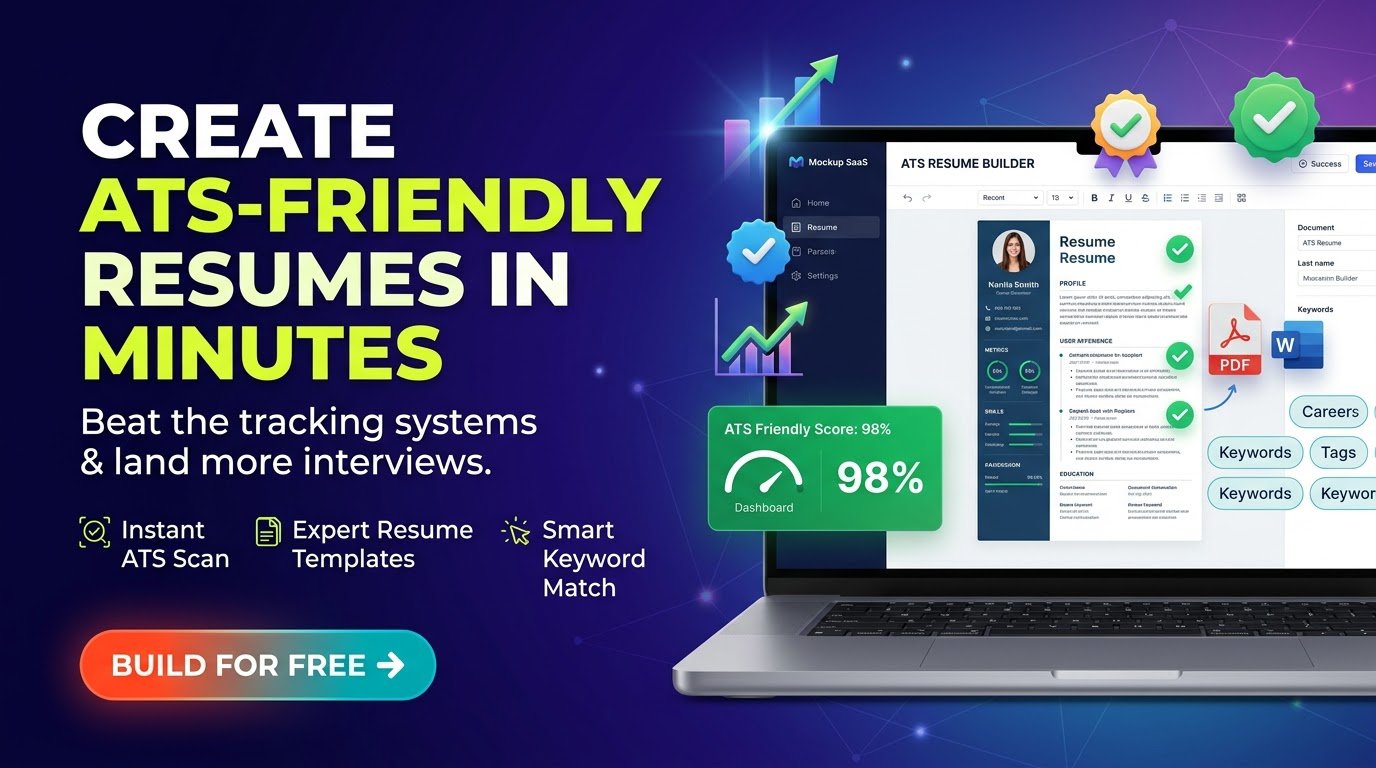
The fastest way to apply all seven rules at once is to start from a template that is already built for them. Trencada’s free Resume Builder uses a single-column layout, standard fonts, and clear section headings, with a live preview and PDF download, so you can focus on your content instead of fighting formatting.
5 ATS Resume Mistakes to Avoid
- Two-column or heavily designed templates. They scramble the reading order for parsers.
- Creative section titles. “My Story” means nothing to the software; “Work Experience” does.
- Keyword stuffing. Repeating terms in invisible text or endless lists backfires.
- Contact details in the header or footer. Parsers often skip these areas, losing your phone number and email.
- Submitting the wrong file type. Image files, Pages documents, or scanned PDFs cannot be parsed. Use a real text-based PDF.
Quick Checklist: Is Your Resume ATS-Friendly?
Run through this list before you hit submit:
- Single-column layout, no tables or text boxes
- Standard font, consistent formatting
- Standard headings: Summary, Work Experience, Education, Skills
- Keywords from the job description appear naturally
- Job titles and dates in plain, standard formats
- No images, graphics, headers, or footers carrying key info
- Saved as a text-based PDF
If every box is checked, your resume will parse cleanly in virtually any applicant tracking system.
Build an ATS-Friendly Resume Free
You do not need expensive software or a designer to get this right. The Resume Builder on Trencada is free, runs entirely in your browser with no signup, and produces a clean single-column resume with a live preview. Fill in your details, check the preview against the checklist above, and download your PDF. Then tailor the keywords for each job you apply to, and you will be giving the software exactly what it wants to see.