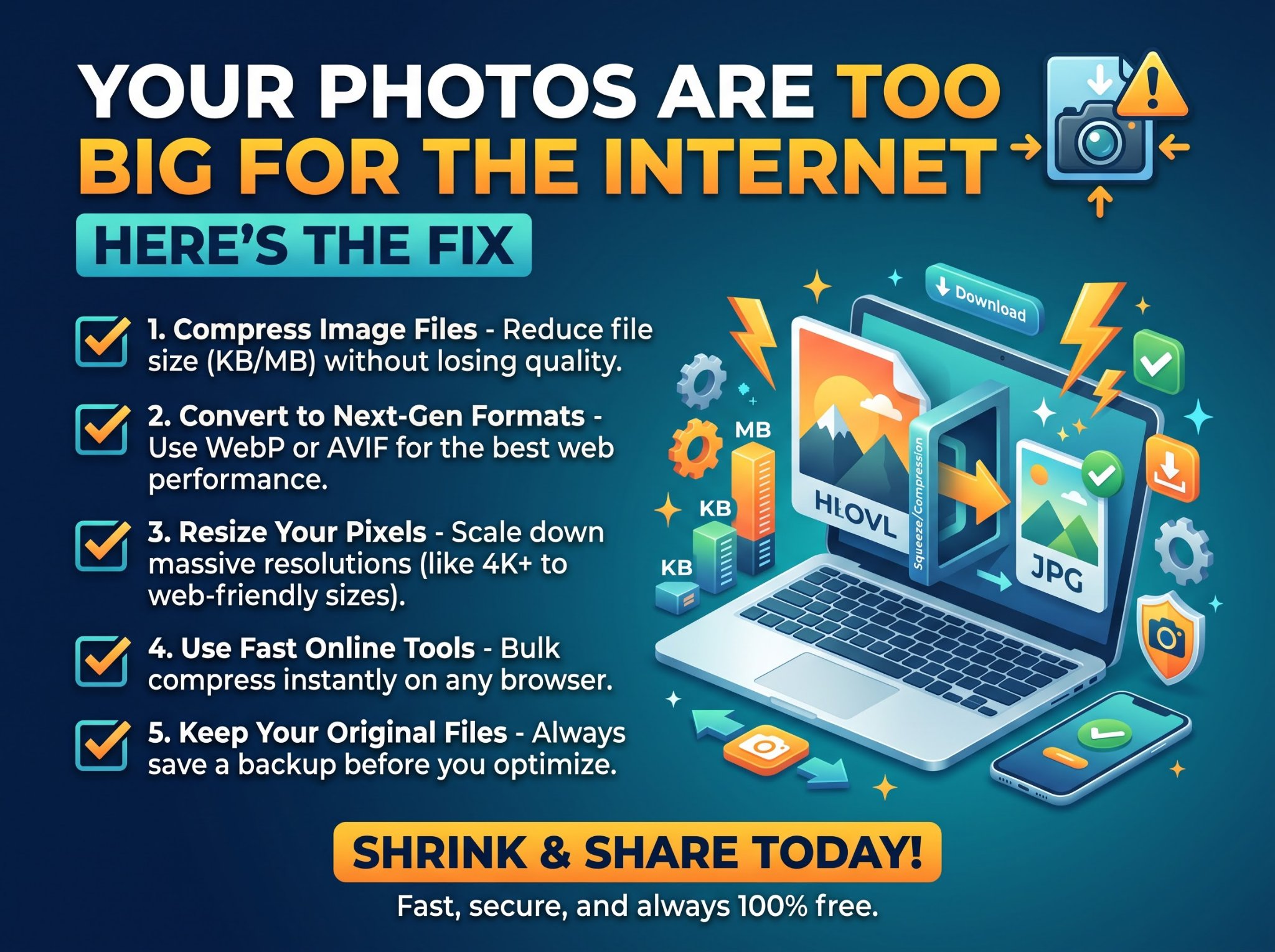
That 8 MB photo from your phone? The website upload form rejects it. The email bounces back. The page you put it on loads like it is stuck in 2007.
Images are the number one reason web pages load slowly — and oversized, unoptimized photos are almost always the culprit. The fix takes seconds, costs nothing, and requires zero technical skill. Here are the three moves that solve 95% of image problems.
1. Remove the Background — Isolate Your Subject in Seconds
Product photos, profile pictures, thumbnails, design mockups — half the time, the background is the problem. A cluttered background distracts. A clean, isolated subject looks professional.
Background removal used to mean Photoshop and a steady hand with the lasso tool. Now it is one upload and one click.
Try it: Background Remover — isolate any subject free
When you need this:
- Product photos for an online store
- LinkedIn or resume headshots without the messy room behind you
- YouTube thumbnails that pop
- Design mockups and social media graphics
Pro tip: Download the result as PNG to keep the transparent background. JPG does not support transparency.
2. Compress the Image — Shrink the File Without Ruining It
A photo straight from a modern phone is 5–12 MB. For web use, you almost never need more than 200–500 KB. A good compressor reduces file size by 70–90% while keeping the image sharp at normal viewing sizes.
Try it: Image Compressor — shrink photos free
When you need this:
- Website images that are slowing down your pages
- Email attachments that keep bouncing
- Upload forms with file size limits
- Saving phone storage space
How much can you save? A typical 8 MB phone photo compresses to 300–600 KB. That is the difference between a 4-second load and an instant one.
3. Convert to a Modern Format — AVIF Is the Future
The JPG format is from 1992. AVIF is the modern image format — same visual quality as JPG at roughly half the file size. It is supported by all major browsers and it is the single highest-impact change you can make to image-heavy pages.
Try it: AVIF Converter — modernize your images free
When you need this:
- Optimizing images for a website or blog
- Reducing bandwidth costs on high-traffic pages
- Sharing high-quality images in smaller files
The 3-Step Workflow
For any image you are about to put online, run this sequence:
- Remove the background if the subject needs to stand alone → Background Remover
- Compress it to shed the invisible excess weight → Image Compressor
- Convert to AVIF for the smallest possible file at full quality → AVIF Converter
Total time: under two minutes. Total cost: zero.
Frequently Asked Questions
Will compression make my photos look bad?
Not at normal viewing sizes. A well-compressed image looks identical on screen.
What is the difference between JPG, PNG, and AVIF?
JPG is best for photos. PNG supports transparency but has larger files. AVIF beats both — smaller than JPG with better quality, and it supports transparency too.
Do I need to install anything?
No. All three tools run in your browser — Chrome, Firefox, Safari, Edge, or your phone’s browser.
Are these really free?
Yes. No signup, no watermarks, no limits.
Is my photo uploaded to a server?
Processing happens in your browser. Your images are not stored anywhere.