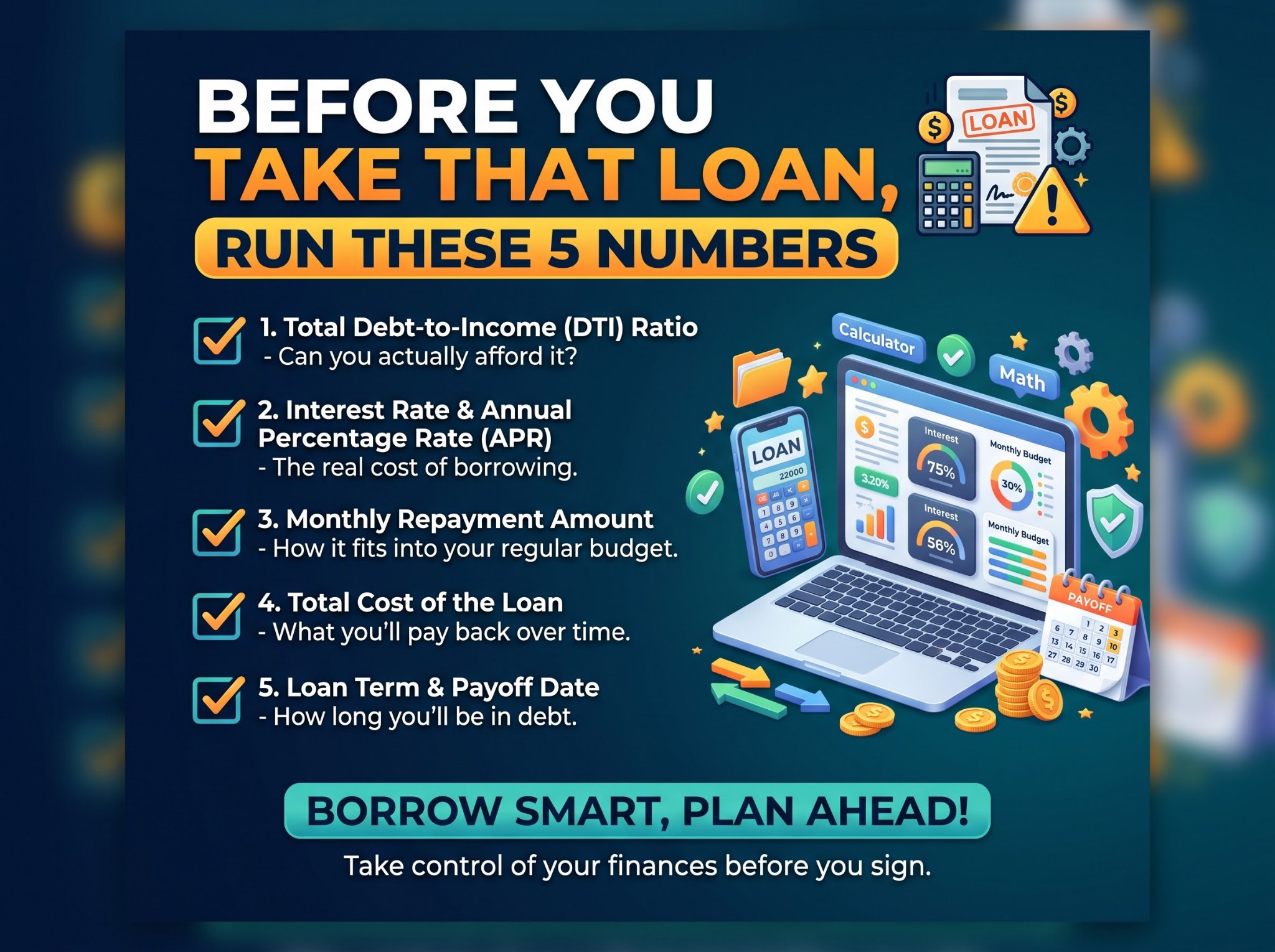
Signing a loan without running the numbers first is like buying a car without checking the price. The monthly payment might look manageable — until you realize what it actually costs you over five years.
Before you sign anything, run these five numbers. Each one takes less than a minute with a free calculator, and together they tell you whether the loan is smart, survivable, or a trap.
1. Your Debt-to-Income (DTI) Ratio — Can You Actually Afford It?
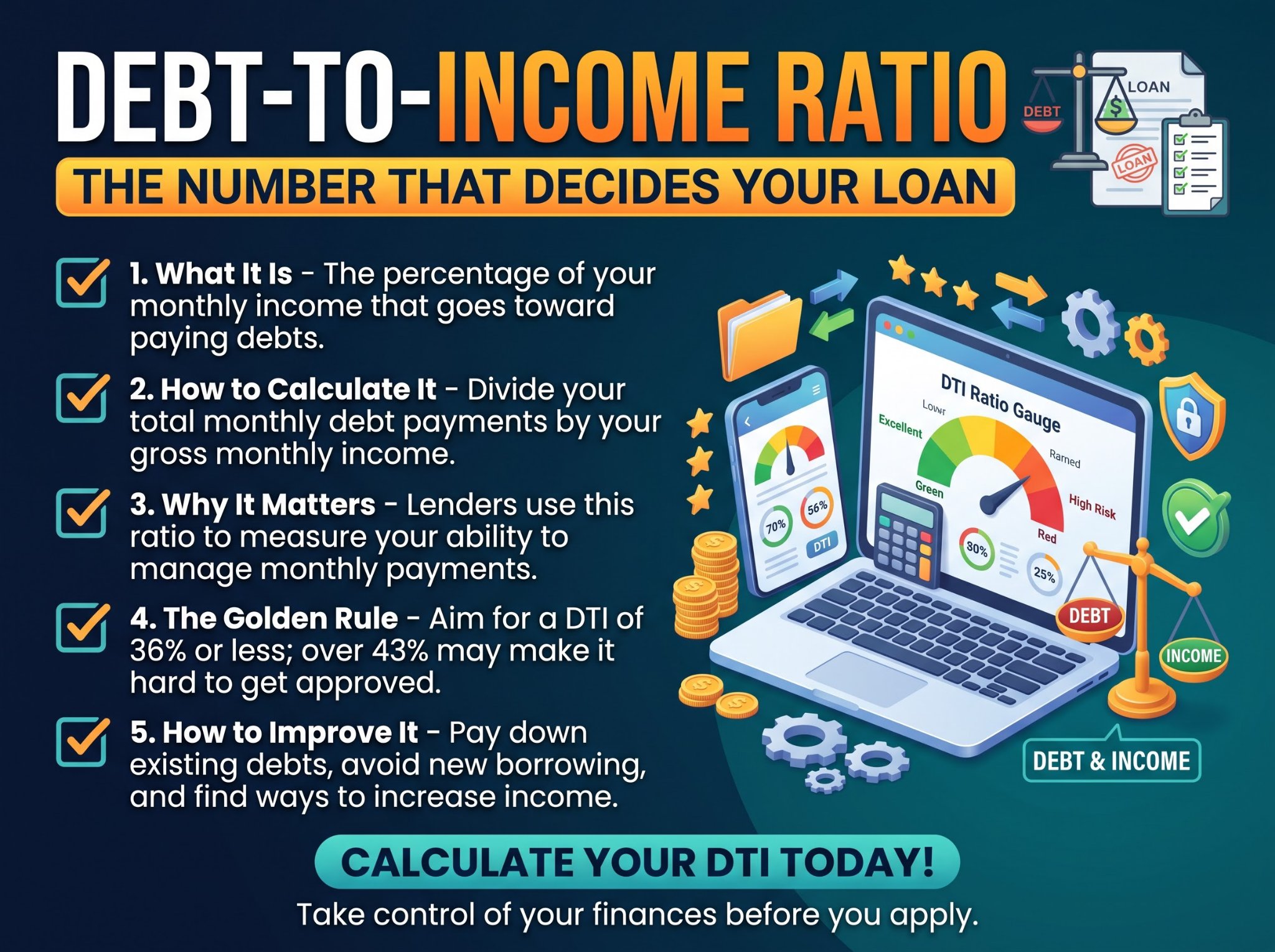
Your debt-to-income ratio is the percentage of your monthly income that goes toward debt payments. Lenders use it to decide whether to approve you. You should use it to decide whether to apply in the first place.
The formula: (Total monthly debt payments ÷ Gross monthly income) × 100
What the number means:
- Under 20% — Comfortable. You have plenty of breathing room.
- 20–35% — Manageable, but watch it. One emergency could strain you.
- 36–43% — The danger zone. Many lenders cap here.
- Over 43% — You probably cannot afford more debt right now.
Try it: Percentage Calculator — run the DTI math free
2. The Interest Rate and APR — The Real Cost of Borrowing
The interest rate is what the lender charges. The APR (Annual Percentage Rate) is what the loan actually costs you per year, including fees. Always compare loans by APR, not by the headline rate.
A single percentage point matters more than most people realize. On a $20,000 loan over 5 years: at 6% APR, you pay about $3,199 in interest. At 9% APR, you pay about $4,939. At 12% APR, you pay about $6,794. That is a $3,500 difference for three percentage points.
3. Your Monthly Repayment — How It Fits Your Budget
The monthly payment is the number you will live with. Run the payment through a loan calculator with your exact loan amount, rate, and term. Then do the reality check: subtract it from your monthly income along with all your other obligations.
The rule of thumb: Your total debt payments should leave you with enough to save at least 10% of your income. If the new payment kills your ability to save, the loan is too big.
Try it: Student Loan Calculator — see your exact monthly payment
4. The Total Cost of the Loan — What You Actually Pay Back
A $20,000 loan is not a $20,000 loan — it is $20,000 plus every dollar of interest over the life of the loan. Longer terms mean lower monthly payments but dramatically higher total cost.
| Loan | Term | Monthly | Total interest | Total repaid |
|---|---|---|---|---|
| $20,000 at 8% | 3 years | $627 | $2,565 | $22,565 |
| $20,000 at 8% | 5 years | $406 | $4,332 | $24,332 |
| $20,000 at 8% | 7 years | $310 | $6,062 | $26,062 |
5. The Payoff Date — How Long You Will Be in Debt
When will you make the last payment? A 7-year car loan means you are driving a 7-year-old car while still making payments on it. An extra $50/month on a $10,000 balance at 12% APR shaves off nearly a year and saves over $600 in interest.
Try it: Debt Payoff Calculator — map your route to zero
Putting It All Together
Here is your pre-loan checklist. Do not sign until you can answer all five:
- DTI ratio — Under 36% including the new payment? → Calculate it
- APR — Do you know the true annual cost, fees included?
- Monthly payment — Does it fit your budget with 10% left to save? → Check it
- Total cost — Have you seen the full repayment amount, not just the loan amount?
- Payoff date — Are you comfortable being in debt until then? → Map it
Frequently Asked Questions
What is a good debt-to-income ratio?
Under 20% is comfortable, 20–35% is manageable, and most lenders get nervous above 43%. Aim to stay under 36% including any new loan.
Should I compare loans by interest rate or APR?
APR. It includes fees and gives you the true yearly cost.
Is a longer loan term always bad?
Not always — lower payments can be the right call if cash flow is tight. But you pay significantly more in total interest, so go in with eyes open.
Are these calculators free?
Yes. No signup, no fees, no limits.