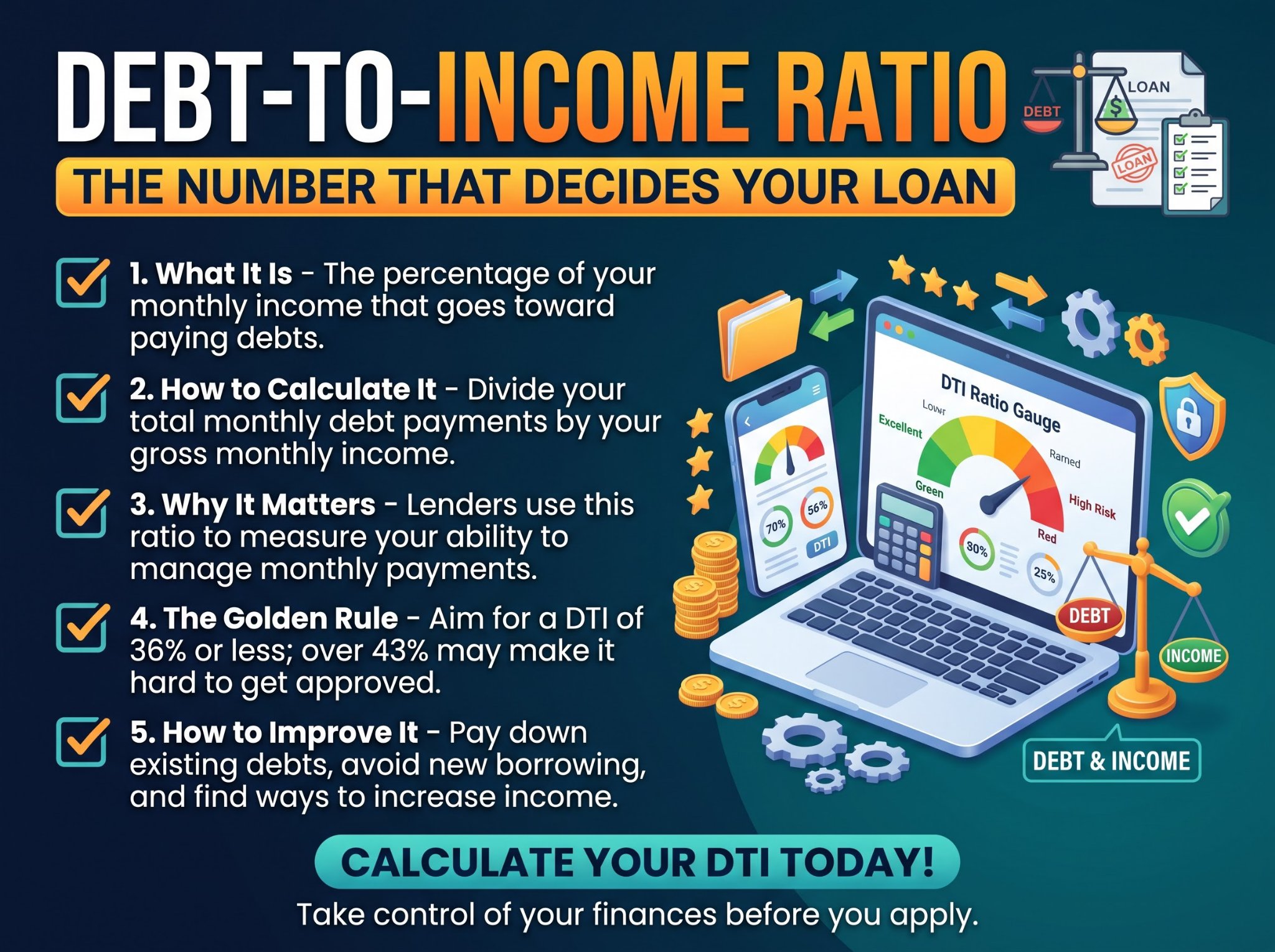
You can have a decent credit score, a steady job, and a solid down payment — and still get denied for a mortgage. The culprit is often a number most borrowers have never calculated: the debt-to-income ratio, or DTI.
Lenders do not just ask “can this person pay?” They ask “can this person pay on top of everything they already owe?” DTI is how they answer it. Understand it before you apply, and you will know exactly where you stand — and what to fix if the number is too high.
Try it: Debt-to-Income Calculator — get your DTI instantly free
1. What the Debt-to-Income Ratio Actually Is
DTI is your total monthly debt payments divided by your gross monthly income, expressed as a percentage.
DTI = (monthly debt payments ÷ gross monthly income) × 100
Example: you earn $6,000 a month before taxes. Your minimum debt payments — car loan, student loans, credit card minimums, plus the housing payment you are applying for — total $1,800. Your DTI is 30%.
That is it. One division problem, and it carries enormous weight in every lending decision you will ever face.
Try it: Percentage Calculator — run the numbers free
What counts as a debt payment:
- Mortgage or rent payment (including the new loan you are applying for)
- Car loan or lease payments
- Student loan payments
- Minimum credit card payments
- Child support or alimony
- Any other minimum monthly loan obligation
What does NOT count: utilities, groceries, insurance premiums, income taxes, and subscriptions. Lenders care about debt, not spending.
2. The Two Ratios Lenders Look At
Mortgage lenders actually compute two versions:
Front-end ratio — housing costs only (mortgage, property tax, insurance, HOA) divided by income. This answers: “can they afford this house?”
Back-end ratio — all monthly debts including housing, divided by income. This answers: “can they afford this house plus their life?”
The back-end ratio is the one that kills applications. Your housing payment alone might look fine at 24% — but add a $450 car payment and $300 in student loans, and suddenly you are at 41%, right against the wall.
3. What Counts as a Good DTI
Thresholds vary by loan type, but the landmarks are consistent:
- Under 36% — the comfort zone. Most lenders view this as healthy, and you will have your pick of loan products.
- 36–43% — the gray zone. Approvable, especially with strong credit, but some lenders will cap your loan amount.
- 43–50% — the ceiling for most qualified mortgages. You can get approved here, but your margin for error is thin.
- Over 50% — very difficult. Most mainstream lenders walk away; you are looking at specialized programs or a “fix the ratio first” conversation.
For auto loans and personal loans the bars are looser, but the direction is the same: lower is always better, and every point matters at the boundary.
4. Calculate Yours in Two Minutes
Grab your numbers and do it now — before a lender does it for you.
- Add up every minimum monthly debt payment, including the housing payment you want (estimate it if you are shopping).
- Take your gross monthly income — before taxes, not take-home. If you are salaried, divide annual salary by 12.
- Divide debts by income, multiply by 100.
Example walkthrough: gross income $7,500/month. Debts: proposed mortgage $1,600 + car $380 + student loans $290 + credit card minimums $120 = $2,390. DTI = (2,390 ÷ 7,500) × 100 = 31.9%. Solid — comfortably under 36%.
Try it: Percentage Calculator — do the division free
Tip: Use minimum payments, not what you actually pay. Lenders use minimums — that $800 you throw at your credit card voluntarily counts as the $45 minimum in their math.
5. How to Lower Your DTI Before You Apply
You have two levers: shrink the debts, or grow the income. In practice, shrinking debts moves the needle fastest.
Kill the smallest balances first. DTI counts monthly payments, not balances. Paying off a $1,200 store card with a $40 minimum removes $40 from the numerator — same effect as paying $40/month off a much larger loan. Target payments, not balances.
Do not open new credit before applying. That new car loan does not just add a payment — the hard inquiry can ding your score at the worst moment.
See your payoff timeline. Knowing exactly when each debt dies tells you when your DTI drops into the safe zone — which tells you when to apply.
Try it: Debt Payoff Calculator — map your debt-free date free
If student loans are the anchor: refinancing or recalculating the payment changes the monthly number lenders see. Model the new payment before you commit.
Try it: Student Loan Calculator — estimate payments free
The income side: a raise, a second income stream, or even a documented side gig counts once it is stable. Overtime counts if it has history.
6. DTI vs. Credit Score: Which Matters More?
Both — but they measure different things, and a great score does not rescue a bad ratio.
- Credit score answers: “does this person repay debts?” (your history)
- DTI answers: “can this person afford this debt?” (your capacity right now)
A 780 score with a 52% DTI gets denied. A 680 score with a 28% DTI gets approved. Lenders need both answers to be yes. If you have been obsessively polishing your score while ignoring the ratio, you have been optimizing the wrong number.
Related tools: Debt-to-Income Calculator · Debt Payoff Calculator · Student Loan Calculator · Percentage Calculator
Frequently Asked Questions
Do lenders use gross or net income?
Gross — before taxes and deductions. This actually helps you, since the denominator is larger than your take-home pay.
Does my DTI affect my credit score?
No, directly. DTI is not reported to credit bureaus and is not part of your score. But the behaviors that raise DTI (high balances, many accounts) often hurt your score independently.
What is a good DTI for a mortgage?
Under 36% is ideal; most conventional loans cap around 45–50% with compensating factors like strong credit or large reserves.
Can I get a loan with 50% DTI?
It is very difficult with mainstream lenders. FHA and VA programs are somewhat more flexible, but above 50% you should generally fix the ratio first.
Do I need to include my partner’s debts?
Only if they are a co-borrower on the loan. If you apply solo, only your debts and your income count — which cuts both ways.
How often should I recalculate?
Any time a debt is paid off, a new one appears, or your income changes — and always before a loan application, so there are no surprises.
The calculators above are part of Trencada’s free collection of 380+ online tools for PDFs, images, text, files, and everyday tasks. Type in your numbers — nothing to upload, no signup needed.