As AI writing tools become more common, more people want to know whether a piece of text was written by a human or generated by a machine. Teachers checking student work, editors reviewing submissions, recruiters reading cover letters — the question comes up everywhere.
Here are five methods that actually work, from quick gut checks to automated analysis.
1. Look for uniform sentence structure
Human writing is messy. We mix short sentences with long, winding ones. We start sentences with “And” or “But.” We interrupt ourselves with asides.
AI-generated text tends to be far more uniform: medium-length sentences, consistent rhythm, predictable paragraph shapes. If every sentence feels like it is the same length and weight, that is a signal.
2. Check the vocabulary
AI models favor common, predictable words. When a human writes, they reach for surprising, specific, or slightly unusual words — the kind that reflect personal experience.
Read a paragraph and ask: does the word choice feel safe and generic, or specific and lived-in? Phrases like “in today’s fast-paced world” or “it is important to note that” appear constantly in AI output and rarely in natural human writing.
3. Test for factual and logical depth
Ask the text a follow-up question in your head. AI-generated content often stays at surface level: correct-sounding but shallow. It summarizes instead of arguing, hedges instead of committing, and avoids the specific details that come from real experience — dates, names, numbers, anecdotes.
Human writing usually contains at least one detail that could only come from someone who was there.
4. Run it through an AI detector
Manual checks are useful but slow. An AI content detector automates the analysis by measuring writing patterns at scale:
- Word unpredictability — how surprising the word choices are
- Sentence burstiness — how much sentence length varies
- Vocabulary richness — how diverse the wording is relative to length
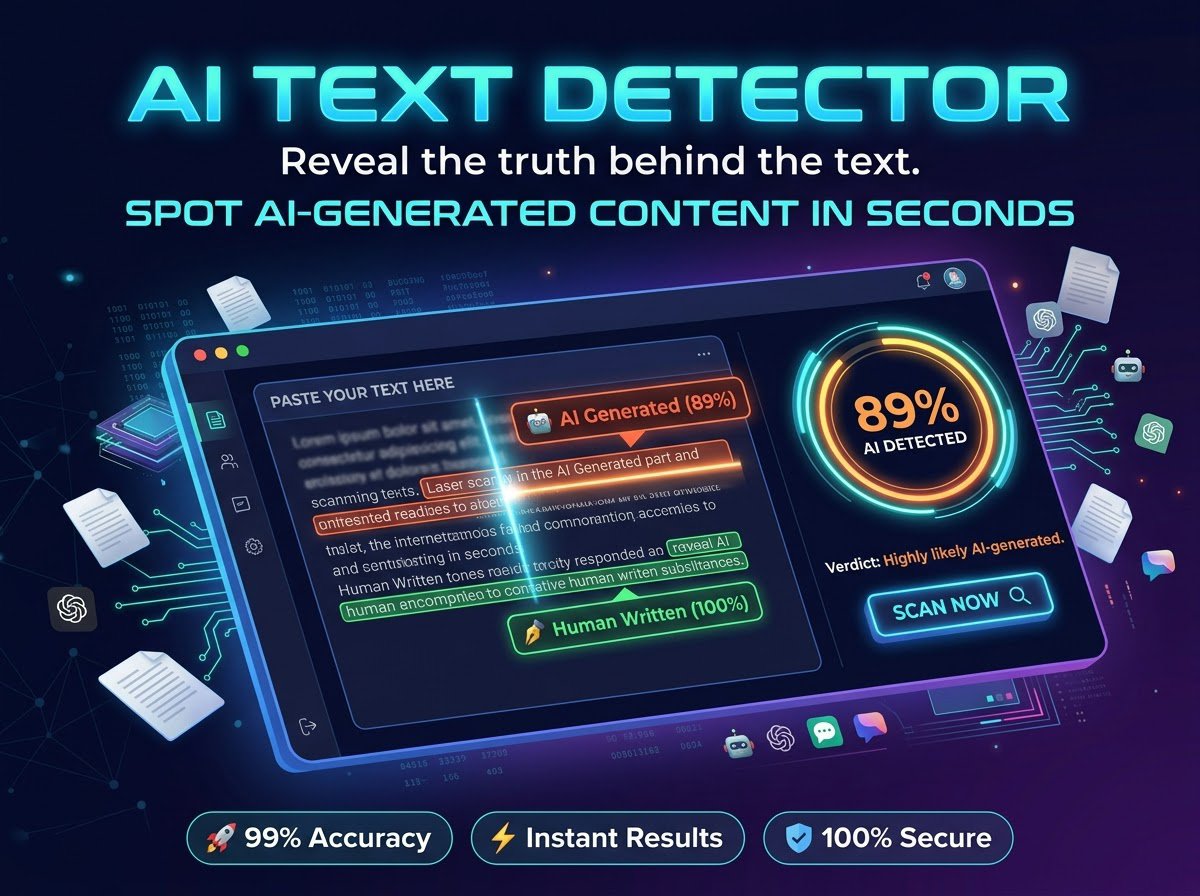
Trencada’s AI Content Detector runs all three checks entirely in your browser — paste up to 5,000 characters, get a 0–100 AI likelihood score with a per-signal breakdown. No signup, no upload, nothing leaves your device.
5. Combine signals — never rely on one
No single method is proof. A skilled human writer can produce uniform text; a well-edited AI draft can look human. The reliable approach is to combine several signals:
- Uniform structure + generic vocabulary + shallow depth = likely AI
- Varied rhythm + specific details + personal voice = likely human
- Mixed signals = inconclusive — and that is an honest answer
The limits of detection
Be upfront about what detection cannot do:
- False positives happen. Non-native speakers and formulaic human writing can score as “AI-like.”
- Short texts are unreliable. Under ~120 words there is not enough data for any method to be confident.
- Editing masks patterns. A human-polished AI draft is genuinely hard to distinguish.
- Detectors are estimates, not evidence. Never use a score as the sole basis for an accusation or a grade.
Bottom line
Spotting AI-generated text is a skill, not a single test. Start with the manual reads — structure, vocabulary, depth — then confirm with an automated check like Trencada’s AI Content Detector. Used together, honestly and with their limits in mind, these five methods give you the best available answer.