The bill arrives, everyone looks at it, and someone says “just split it evenly” while someone else quietly ordered a salad. Tipping is simple arithmetic wrapped in social pressure, and most of the awkwardness comes from not knowing the few rules that settle it. This guide covers the formula, how much to tip for each kind of service, how to split a bill evenly or unevenly, the auto-gratuity trap that double-charges you, and how tipping works outside the United States. Every worked number below was recomputed for this article.
How much to tip, in 30 seconds
- The formula is always the same: tip = bill x tip percentage. A $120 bill at 18% gives a $21.60 tip and a $141.60 total.
- For sit-down restaurant service in the US, 15% is acceptable, 18 to 20% is standard for good service, and 25% or more is for exceptional service. When in doubt, 20% is never wrong.
- Tip on the pre-tax subtotal, not the total with tax. On a $100 bill with 8% tax, 20% pre-tax is $20.00 and 20% post-tax is $21.60: a $1.60 difference that is small on one bill and real over a year.
- Splitting evenly is only fair when everyone ordered roughly the same. When orders differ, split in proportion to what each person ordered.
- Always check for a service charge or auto-gratuity before adding a tip. Tipping on top of an 18% auto-gratuity can quietly push your total tip to 38%.
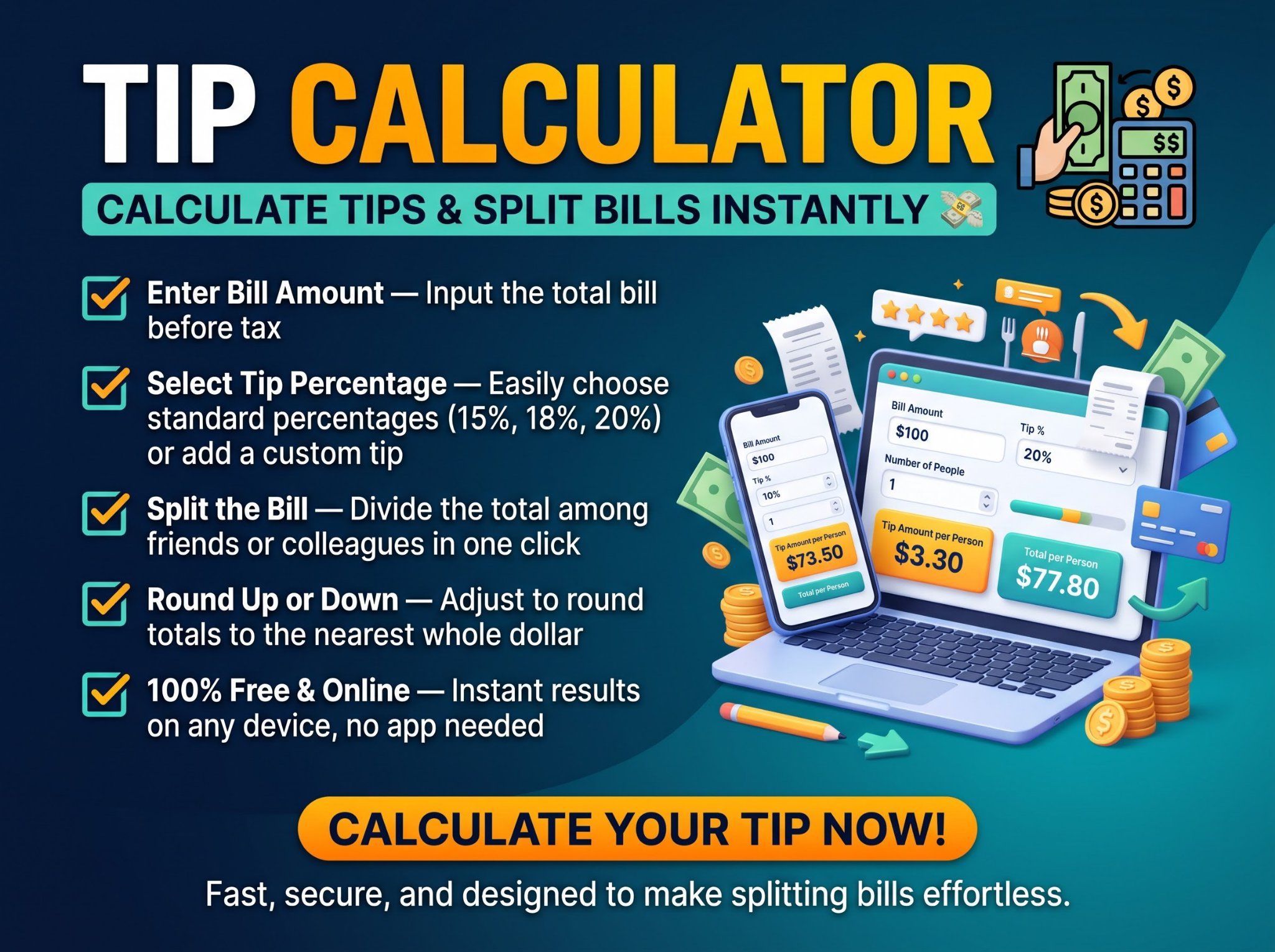
- Use the free tip calculator to run all of this instantly, including uneven splits and rounding the total to a clean number.
The formula
Tip amount = bill amount x (tip percentage / 100). Total bill = bill amount + tip amount. Per person = total bill / number of people.
Worked example: a $120 bill, 18% tip, split three ways. Tip = $120 x 0.18 = $21.60. Total = $141.60. Each person pays $47.20. If the group prefers a clean number, rounding the total up to $145 makes each share $48.34, which is a slightly more generous tip for the sake of simple math. The calculator’s round-up option does exactly this step for you.
If percentages slow you down, the percentage calculator runs the same arithmetic in isolation. The skill is the same either way: pick the percentage first, then multiply.
How much to tip by service
These are US norms. The ranges below reflect what the small calculator sites and etiquette guides agree on, and they are the ranges the calculator’s presets (10, 15, 18, 20, 25%) are built around.
| Service | Typical tip | Notes |
|---|---|---|
| Sit-down restaurant | 15 to 20% (20% for good service) | 25% or more for exceptional service; 10 to 15% only when service had real problems |
| Bar and drinks | $1 to $2 per drink, or 15 to 20% | Per-drink tipping is the norm for simple orders |
| Food delivery | 15 to 20%, minimum $3 to $5 | More for bad weather, distance, or large orders |
| Cafe and counter service | 10 to 15%, or nothing | Tipping here is appreciated but genuinely optional |
| Taxi and rideshare | 15 to 20% | Round up at minimum; 20% for heavy traffic or extra help |
| Hotel housekeeping | $3 to $5 per night | Leave it daily, since staff rotates |
| Hotel porter | $2 to $3 per bag | Tip when the bags arrive, not at checkout |
| Valet | $3 to $5 | Tip when the car is returned |
| Hair salon and barber | 15 to 20% | Tip the stylist directly, and the assistant too if there is one |
| Spa and massage | 18 to 20% | Skip only when gratuity is explicitly included |
Two rules cut across the whole table. First, tip on the service, not on the tax: the server did not set the tax rate. Second, tip on the full price, not the discounted price: if a $100 meal is discounted to $80 with a coupon, a 20% tip on the full price is $20.00, not $16.00. The server carried the same plates either way. The discount calculator is handy for separating the discounted total from the pre-discount price you should tip on.
Pre-tax or post-tax? The honest answer
Etiquette says pre-tax. Practice is mixed: many people tip on the post-tax total because that is the number printed at the bottom of the receipt, and plenty of card machines default to it. The difference is small on a single meal and worth knowing rather than worrying over. On a $100 bill with 8% tax, the bill with tax is $108.00. A 20% tip on the pre-tax $100 is $20.00; on the post-tax $108 it is $21.60. The $1.60 gap is the price of convenience, and either choice is socially acceptable. If you want the exact tax figure separated from the bill, the sales tax calculator breaks it out for you.
Splitting evenly
Even splitting divides the total, tip included, equally. It is fast and fair when orders were similar. A $120 bill at 18% is $141.60; split three ways, each person pays $47.20. The calculator’s Even split mode does this in one step, and its round-up option turns awkward totals into clean ones: an $86.40 bill at 20% is $103.68, rounded up to $105, which makes the tip $18.60 (about 21.5%) instead of $17.28.
Even splitting breaks down when one person ordered a steak and another a soup. That is the next section, and it is the one most groups get wrong.
Splitting unevenly: the fair way
When orders differ, each person’s share of the total (bill plus tip) should be proportional to what they ordered. The formula: person’s share = (person’s order / total bill) x total with tip.
Worked example: two friends, total bill $140, 20% tip. Tip = $28.00, total with tip = $168.00. One ordered $90 of food, the other $50. The first pays ($90 / $140) x $168 = $108.00. The second pays ($50 / $140) x $168 = $60.00. The two shares add to exactly $168.00.
This is not a gap in Trencada’s tool: the tip calculator has an Uneven split mode that does exactly this. Enter what each person ordered, and each share of the total comes out proportional to their amount. Use it whenever the even split would quietly overcharge the light eater, which is the most common bill-splitting resentment there is.
The auto-gratuity trap
Many restaurants add an automatic gratuity of 18 to 20% for parties of six or more, and it is easy to tip again on top without noticing. Read the bill before you tip. The trap, worked out: a $200 bill with an 18% auto-gratuity already includes a $36.00 tip. Adding another 20% on top adds $40.00, for a total tip of $76.00, which is 38% of the bill. Nobody intends that.
The legal distinction matters too. Under the IRS rules on tips, service charges added to a bill or fixed by the employer that the customer must pay are not tips at all: they are non-tip wages, and the examples the IRS lists include large-party charges, bottle service charges, room service charges, and mandated delivery charges. A mandatory charge is the house’s money, distributed as wages. A voluntary tip is the server’s. When the bill shows a service charge, that is your cue to check whether an additional tip is wanted at all, and if you do add one, to size it knowing the charge is already there.
Tipping around the world
US norms do not travel. Tipping is a local custom, and the same percentage that is polite in one country is odd or even unwelcome in another.
- United States: 15 to 20% at sit-down restaurants is the core norm, and tipping is woven into how service staff are paid (see below).
- United Kingdom: 10 to 12.5% is typical at sit-down restaurants, and many places already add a discretionary service charge. Check the bill before tipping on top.
- Europe: service is often included in the price, especially in France and Germany. Rounding up or leaving 5 to 10% is common; 20% is unusual.
- Asia: tipping is uncommon in Japan and China and can even be refused; in parts of Southeast Asia a small tip is appreciated but not expected.
- Middle East and elsewhere: norms vary widely by country and venue. When unsure, ask a local or check whether a service charge is already on the bill.
The safe rule abroad: look for a service charge first, then follow the local norm, not the American one.
Counter service and tip fatigue
Tip prompts now appear at coffee counters, food trucks, and self-checkout screens, and many people feel pressured by them. The honest position: tipping at a counter where you ordered standing up and carried your own food is optional. A 10 to 15% tip is a kind gesture for a regular spot or genuinely good service, and zero is acceptable when there was no table service. Tip fatigue is real, and it is not rudeness to decline a prompt for a transaction that involved no service beyond the sale. Save the generous percentages for the people who actually served you.
Cash or card?
Both work, and each has a wrinkle. Cash tips go directly to the server immediately, which some servers prefer. Card tips are recorded, which matters for the server’s reported income and for tip pools, and they are easier to split exactly. One practical note: if you tip on a card, write the tip amount clearly and keep your copy of the receipt until the charge settles, since a misread digit is the most common tip dispute there is.
Tip pools: how staff share
In many restaurants, tips are pooled and shared by hours worked rather than kept by the individual server. The calculator’s Tip pool section does this math: enter the total tips and each person’s hours, and the pool is shared in proportion to hours. Worked example: a $120.00 pool shared by three staff who worked 6, 4, and 2 hours. Total hours are 12, so the shares are $60.00, $40.00, and $20.00. Pooling is also why a tip on a card can be fairer than cash in a team-service setting: it enters the pool instead of one person’s pocket.
Why tips matter this much in the US
In the US, tipping is not just custom; it is part of the wage structure. Under federal law, employers may pay tipped workers a direct cash wage as low as $2.13 per hour and claim a tip credit of up to $5.12 per hour against the $7.25 federal minimum wage, provided tips actually bring the worker to at least $7.25. That is the arrangement shown in the Labor Department’s tipped-wage table, and several states set higher cash wages or ban the tip credit entirely, requiring the full state minimum wage before tips. The practical meaning for the customer is simple: in states that allow the federal cash wage, the tip is not a bonus on top of a full wage. It is a large part of the wage itself, which is why the 15 to 20% norm carries real weight.
Common mistakes
- Tipping on top of an auto-gratuity. Always read the bill first. Parties of six or more are the usual trigger.
- Splitting evenly when orders differed. Use the uneven split; the light eater notices.
- Tipping on the discounted price. Tip on the full price before coupons.
- Tipping on the post-tax total without realizing it. Fine if deliberate, but know it costs about $1.60 extra per $100 at 8% tax.
- Forgetting delivery minimums. A 15% tip on a $12 order is $1.80, which is below any reasonable minimum. Use the $3 to $5 floor.
- Tipping the US percentage abroad. Check for an included service charge and follow the local norm.
- Leaving no tip for bad service as a protest. If service had real problems, 10 to 15% plus a word with the manager communicates more than zero, which reads as forgetfulness.
Frequently asked questions
How much should I tip at a restaurant?
In the US, 15 to 20% for sit-down service: 15% for acceptable service, 18 to 20% for good service, 25% or more for exceptional service. Tip on the pre-tax subtotal.
How do I calculate a tip?
Multiply the bill by the tip percentage: a $120 bill at 18% gives a $21.60 tip and a $141.60 total. The free calculator does this plus splitting and rounding.
Should I tip on tax?
Etiquette says tip on the pre-tax amount. Tipping on the post-tax total is common and acceptable, but it costs a little more: $1.60 extra per $100 at 8% tax and 20%.
How do I split a bill when everyone ordered different things?
Split in proportion to each order: each person’s share is (their order / total bill) x total with tip. The calculator’s Uneven split mode does this directly.
What is an auto-gratuity, and do I tip on top of it?
An automatic service charge, usually 18 to 20% for large parties. Check the bill first: it is already a tip-sized amount, and the IRS treats mandatory service charges as wages, not tips. Add more only deliberately.
Do I have to tip at a coffee counter?
No. Counter tipping is optional. Ten to 15% is a kind gesture for a regular spot; zero is acceptable when there was no table service.
Is it rude to tip less than 20%?
No. Fifteen percent is acceptable for average service, and the percentage should reflect the service. Twenty percent is the safe default for good service, not a floor for all service.
Sources
- Internal Revenue Service, Topic no. 761, Tips – withholding and reporting
- U.S. Department of Labor, Minimum Wages for Tipped Employees