You have heard “drink eight glasses a day” so often it sounds like science. It is not. The real answer to how much water you should drink per day depends on your body weight, how active you are, and how hot your climate is — and the most-cited official figures are not even about plain water. This guide gives you your number three ways: the official reference values, a weight-based formula you can do in your head, and adjustments for exercise and heat. Every worked number below was recomputed for this article.
The answer in 30 seconds
- The U.S. National Academies’ adequate intake for total water is 3.7 liters a day for men and 2.7 liters for women — but that counts all beverages plus the water in food. The drinks portion is about 3.0 liters for men and 2.2 liters for women.
- A personalized starting point is 30 to 35 ml of water per kilogram of body weight per day. A 70 kg adult lands at 2.1 to 2.45 liters; a 100 kg adult at 3.0 to 3.5 liters.
- Add roughly 350 to 700 ml for each hour of sweaty exercise, and more in hot or humid weather.
- Eight 8-ounce glasses is 64 ounces, or 1.89 liters. Reasonable for a smaller, inactive adult; short for a larger or active one.
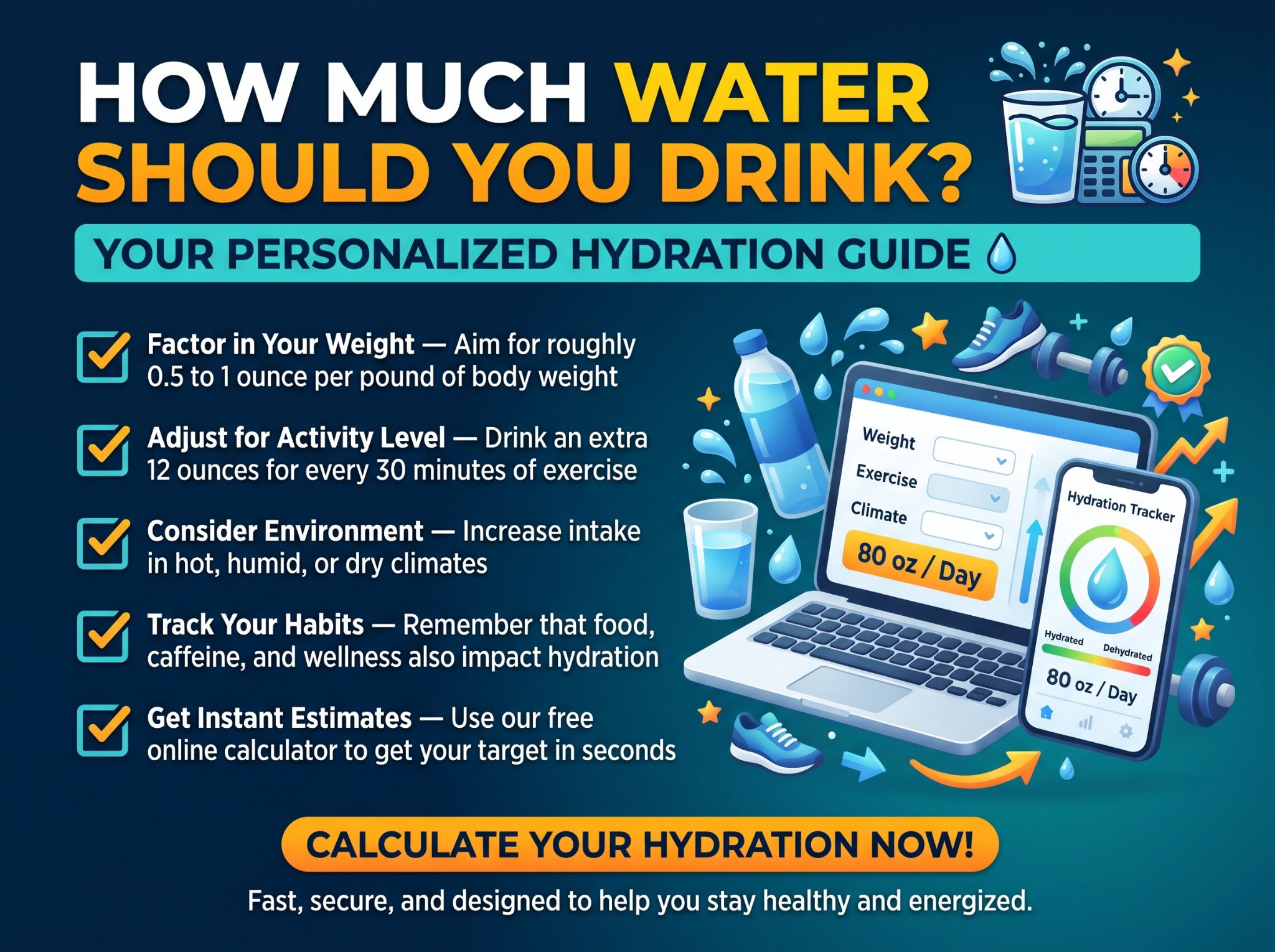
- Use the free water intake calculator to personalize it: enter your weight, activity level, and climate, and it gives your target in glasses or bottles.
The official numbers, and what they actually mean
The figures everyone quotes come from the U.S. National Academies’ Dietary Reference Intakes for water. They are adequate intakes: the amounts observed in healthy, well-hydrated populations, not minimums you must hit or prescriptions for any individual.
| Group | Total water (food + drinks) | From drinks, about | In cups (8 oz) |
|---|---|---|---|
| Men | 3.7 liters (125 oz) | 3.0 liters (101 oz) | 15.5 total / 12.7 from drinks |
| Women | 2.7 liters (91 oz) | 2.2 liters (74 oz) | 11.5 total / 9.3 from drinks |
The distinction between total water and drinks is the one most articles skip, and it changes everything. About 20% of daily water comes from food — fruits, vegetables, soups, even bread and cereal contain water. So when a headline says “men need 3.7 liters,” nobody is expected to drink 3.7 liters of plain water. The drinking target is closer to 3.0 liters for men and 2.2 liters for women, and even that includes tea, coffee, milk, and juice, not just water.
These are also population averages for healthy adults in temperate climates. They do not know your weight, your workouts, or your weather. That is why the next section personalizes them.
Your number from your weight
The most widely used personalization is simple: multiply your body weight in kilograms by 30 to 35 ml. The lower end suits smaller, less active people; the upper end suits larger or more active ones.
| Body weight | Daily baseline (30–35 ml/kg) | In US ounces |
|---|---|---|
| 50 kg (110 lb) | 1.50–1.75 liters | 51–59 oz |
| 60 kg (132 lb) | 1.80–2.10 liters | 61–71 oz |
| 70 kg (154 lb) | 2.10–2.45 liters | 71–83 oz |
| 80 kg (176 lb) | 2.40–2.80 liters | 81–95 oz |
| 90 kg (198 lb) | 2.70–3.15 liters | 91–107 oz |
| 100 kg (220 lb) | 3.00–3.50 liters | 101–118 oz |
A popular shortcut gives nearly the same answer: drink half your body weight in ounces. A 150 lb adult gets 75 ounces (2.22 liters); a 200 lb adult gets 100 ounces (2.96 liters). Compare with the table: 150 lb is about 68 kg, and 68 kg at 33 ml/kg is 2.24 liters, or about 76 ounces. The two rules agree because they are the same idea in different units. Use whichever is easier to remember.
Worked example: a 70 kg adult with light activity. Baseline at 33 ml/kg is 70 x 33 = 2,310 ml. Add 350 ml for light activity and the target is 2,660 ml, or 2.66 liters — about 11 standard 250 ml glasses, or just over five 500 ml bottles. A second example: an 80 kg adult, moderately active. Baseline at 35 ml/kg is 2,800 ml, plus 550 ml for activity, for 3,350 ml — 3.35 liters, about 13 to 14 standard glasses, or 99 ounces.
If you track weight and health goals together, the BMI calculator and the calorie calculator use the same weight input, and the body fat guide explains what body composition adds to the picture: how to calculate body fat percentage.
Adjusting for exercise, heat, and illness
The baseline assumes an ordinary day in a temperate climate. Real days add losses, and each one raises the target.
- Exercise: add roughly 350 to 700 ml (about 12 to 21 ounces) for each hour of activity that makes you sweat, more for intense sessions in heat. An hour-long run on a hot day can cost over a liter in sweat alone.
- Hot or humid climate: sweat losses rise sharply, and so does the target. The water calculator’s hot and humid setting exists for exactly this: same weight, same activity, higher number.
- Illness: fever, vomiting, and diarrhea all increase fluid loss. Oral rehydration solutions help here, since they replace salts as well as water.
- Pregnancy and breastfeeding: reference values rise — about 3.0 liters total during pregnancy and 3.1 liters while breastfeeding, against the 2.7 liter baseline for women.
Two groups need individual advice rather than this guide’s numbers: people whose doctors have told them to limit fluids (some heart, kidney, or liver conditions), and endurance athletes training for hours, where drinking far beyond thirst can dilute blood sodium. For everyone else, the adjustments above are the whole story.
The 8-glass rule, honestly assessed
Eight glasses of 8 ounces is 64 ounces, or 1.89 liters. Against the table above, that is a reasonable daily drinks target for a 50 to 60 kg adult with a quiet day, and an underestimate for almost everyone bigger or more active. An 80 kg adult’s baseline alone is 2.40 to 2.80 liters — the 8-glass rule leaves them 0.5 to 0.9 liters short before exercise is even counted.
The rule survives because it is simple and because it is not wildly wrong for small adults. Its real flaw is that it was never personal: it ignores body size, activity, and climate, the three things that actually move the number. Keep it only as a floor, not a target. If you weigh 90 kg and train most days, eight glasses is a starting point you should expect to exceed.
What counts toward your number
Nearly all fluids count. Plain water is the simplest choice, but tea, coffee, milk, juice, and soups all contribute — the old idea that caffeinated drinks dehydrate you has been dropped by current guidance. Food counts too, at roughly 20% of the total: watermelon is about 92% water, cucumber about 95%, and even bread contributes some.
What does not count is alcohol. It increases fluid loss rather than replacing it, so a drink with dinner is not progress toward your target. Sugary drinks count as fluid but carry calories you probably do not want; water is the only option that adds nothing else.
How to tell you are drinking enough
Two checks beat any calculator, because they measure your body rather than an average:
- Thirst: if you rarely feel thirsty, your intake is probably adequate. Thirst is a genuine regulatory signal, not a late warning for most healthy adults — though it weakens with age, which is one reason older adults dehydrate more easily.
- Urine color: colorless or light yellow (pale straw) indicates adequate hydration. Dark yellow means drink more. Vitamin supplements can darken urine and confuse this check, so read it alongside thirst, not instead of it.
If both checks look good on a number below the table’s baseline, trust your body over the table. The table is a planning aid; your kidneys are the measurement.
Can you drink too much?
For healthy adults, overhydration is rare, because the kidneys excrete excess water efficiently. The risk case is specific: drinking large volumes in a short time — well beyond thirst — during prolonged exercise, which can dilute blood sodium, a condition called hyponatremia. The practical guardrail is simple: spread your intake through the day, drink to thirst plus your planned amount, and do not force liters in a single sitting to “catch up.” If a doctor has set you a fluid limit, that limit overrides everything in this guide.
Making it a habit
A target only works if you can see it. Translate your number into containers you actually use. A 2.66 liter target is about eleven 250 ml glasses, about eight 330 ml bottles, or just over five 500 ml bottles. Fill a bottle in the morning and count refills instead of counting glasses.
Anchor drinking to routines you already have: a glass on waking, one with each meal, one during exercise, one in the afternoon. The water intake calculator lets you pick your glass size — standard 250 ml, small 200 ml, a 330 ml bottle, or a 500 ml bottle — so the target comes back in units you can actually count.
Frequently asked questions
How much water should I drink per day if I exercise daily?
Start from your weight baseline, then add roughly 350 to 700 ml per hour of sweaty exercise. A 70 kg adult training an hour a day lands near 2.5 to 3.2 liters from drinks and food combined, before any heat adjustment.
Does coffee count?
Yes. Current guidance counts caffeinated drinks toward daily fluid intake. Coffee is not as hydrating per cup as plain water, but it is not dehydrating either.
Is eight glasses a day a rule?
No. It is not an official recommendation and has no strong scientific origin. It happens to suit smaller, inactive adults and undershoots larger or active ones.
Should I drink a fixed amount even when I am not thirsty?
Drink steadily through the day rather than forcing a quota. If you rarely feel thirsty and your urine is pale yellow, you are drinking enough, even if the number is below a published average.
Do children need the same formula?
No. Children’s fluid needs are set by age and weight on pediatric tables, and this guide’s adult figures do not apply to them. The same goes for anyone with a medical fluid restriction: follow your doctor’s number, not this guide’s.
The one-line version
Start at 30 to 35 ml per kilogram of body weight, add 350 to 700 ml per hour of sweaty exercise and more for heat, count all drinks plus the roughly 20% that comes from food, and check thirst and urine color rather than chasing a single magic number. Run your own numbers in the water intake calculator.
This guide is general educational information, not medical advice. If you have a heart, kidney, or other condition that affects fluid balance, or you are pregnant or breastfeeding, ask your doctor or dietitian for your personal target.