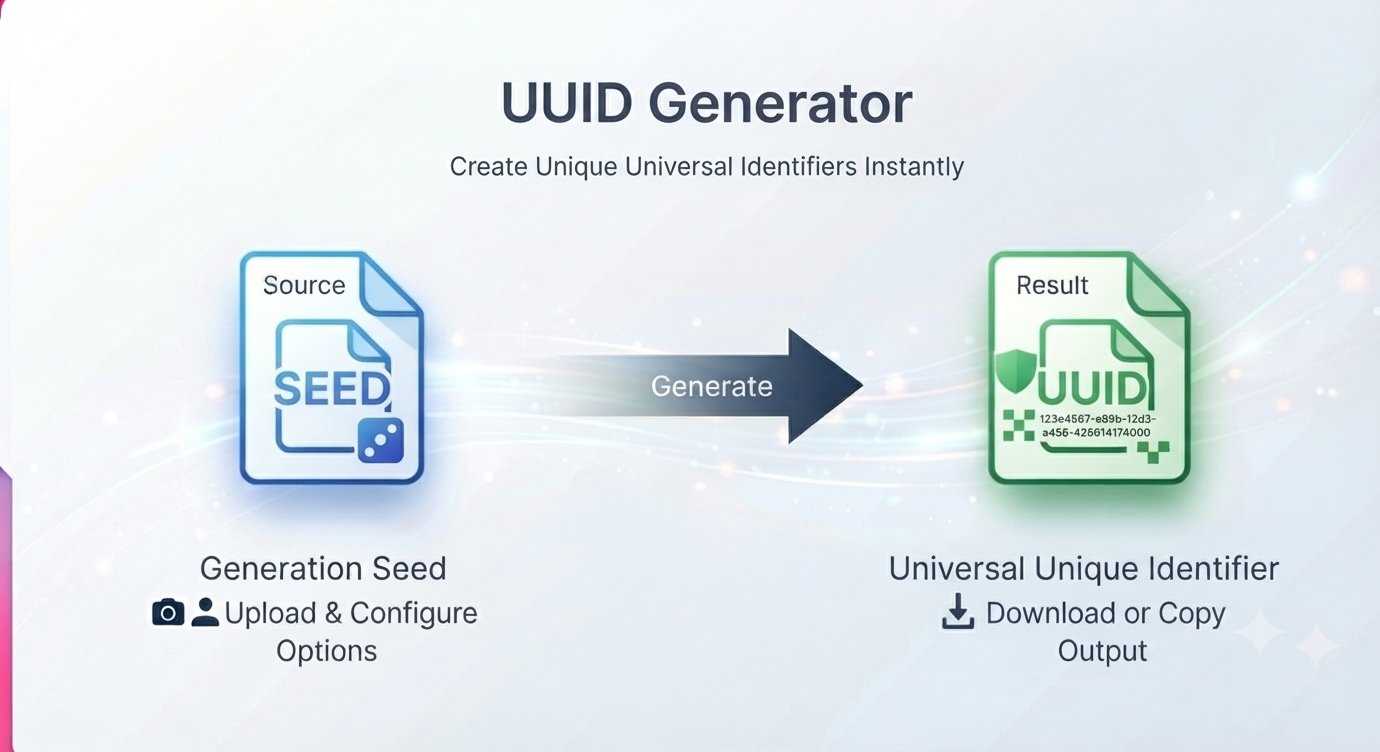
You’re setting up a database table and every row needs a unique ID. Or you’re writing an API and each request needs a tracking identifier that will never collide with another. You could hand-craft IDs and hope for the best — or you could generate a UUID online free and get a guaranteed-unique identifier in one click.
This guide explains what UUIDs are, when to use them (and when not to), and how to generate them instantly without writing code.
What is a UUID?
A UUID (Universally Unique Identifier) is a 128-bit label written as 32 hexadecimal characters in five groups, like this:
550e8400-e29b-41d4-a716-446655440000
The key property: UUIDs are generated randomly (version 4) in a space so enormous — 2122 possible values — that the chance of two ever colliding is effectively zero. You don’t need a central authority handing out numbers; any device, anywhere, can mint one independently and it’s still unique.
When do you actually need a UUID?
- Database primary keys. Especially in distributed systems where multiple servers create records simultaneously and auto-incrementing numbers would clash.
- API request IDs. Tag each request with a UUID for tracing through logs and microservices.
- File and upload names. Name user uploads with UUIDs to avoid filename collisions.
- Session and transaction tokens. Unique identifiers for payments, orders, and user sessions.
- Merging datasets. Combine records from different sources without ID conflicts.
When NOT to use a UUID
- Short public URLs. UUIDs are long and ugly — use a shorter ID scheme for user-facing links.
- Sequential ordering matters. Random UUIDs don’t sort chronologically; use auto-increment or time-ordered IDs instead.
- Tiny embedded systems. 36 characters is heavyweight where every byte counts.
- Anything needing secrecy. UUIDs are unique, not secret — don’t use them as passwords or security tokens.
How to generate a UUID online free
A free UUID generator runs right in your browser — no signup, no software, no command line.
Step by step
- Open the generator in your browser.
- Choose how many UUIDs you need (one, or a whole batch).
- Click generate — your UUIDs appear instantly.
- Copy and paste them into your database, code, or config.
That’s it — no uuidgen terminal commands, no npm packages, no Stack Overflow copy-paste.
UUID versions: which one are you getting?
- Version 4 (random) — the most common. Generated from random numbers; what most online generators produce.
- Version 1 (time-based) — embeds a timestamp and machine identifier; sortable but leaks timing info.
- Version 7 (time-ordered) — the modern best of both: sortable like v1, random like v4. Gaining adoption fast.
For the vast majority of uses — database keys, request IDs, test data — version 4 random UUIDs are exactly right.
UUID FAQ
Is the UUID generator free?
Yes — generate as many UUIDs as you need, free, with no signup.
Are generated UUIDs really unique?
Effectively yes. The collision probability of properly generated v4 UUIDs is so low it’s not worth worrying about — you’d need to generate billions per second for a century to expect one duplicate.
Can I generate multiple UUIDs at once?
Yes — generate a batch in one click when you need several identifiers.
Is a UUID the same as a GUID?
Essentially yes. GUID is Microsoft’s name for the same 128-bit identifier format.
Can I use a UUID as a password?
No. UUIDs are unique, not secret — they’re designed to be identifiers, and v4 UUIDs have less entropy than a proper random password. Use a password generator for secrets.
Do I need to install anything?
No — the generator works directly in your browser on desktop, tablet, or mobile.
Need a batch of unique IDs for a database, API keys, or test fixtures? Generate as many as you want — free, no signup, no limits. Generate UUIDs free — no signup